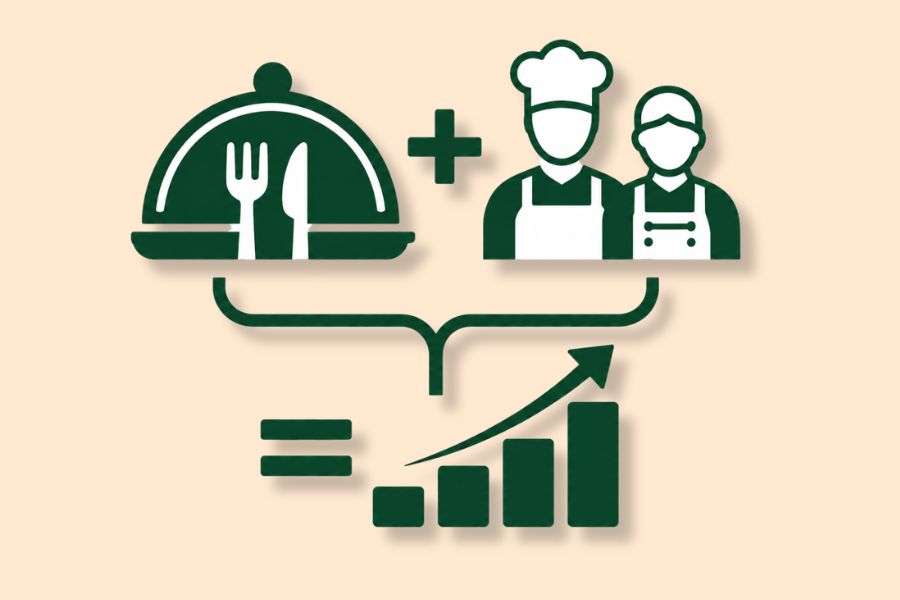


The restaurant break-even point is an essential financial metric for understanding how much revenue a food service business needs to generate to cover its operating expenses.
Many restaurant operators monitor daily sales closely but have not calculated the minimum revenue required to sustain their operations.
Understanding the break-even point helps management establish realistic sales targets, evaluate cost structures, and make better financial decisions.
It is particularly useful for restaurants facing seasonal demand, rising operating expenses, or changes in their pricing strategy.
What Is a Restaurant Break-even Point?
The break-even point represents the level of sales at which total revenue equals total expenses.
At this point, a restaurant covers the operating costs included in its financial model without generating an operating profit or loss.
Calculating it requires separating expenses into fixed and variable costs.
Fixed Costs
Fixed costs remain relatively stable within a defined operating range, regardless of short-term changes in sales volume.
Examples may include rent, insurance, administrative expenses, and the fixed portion of payroll.
Variable Costs
Variable costs change according to sales or production volume.
Examples include food and beverage ingredients, packaging, delivery platform commissions, and certain labor expenses directly linked to demand.
Some expenses contain both fixed and variable components. These should be separated when possible to produce a more accurate calculation.
How to Calculate a Restaurant Break-even Point
The break-even calculation depends on fixed operating costs and the restaurant’s contribution margin.
Contribution margin represents the amount of revenue remaining after variable expenses are deducted.
This amount is available to cover fixed costs and eventually generate profit.
The basic formula is:
Break-even Revenue = Fixed Costs / Contribution Margin Ratio
The contribution margin ratio is calculated as:
Contribution Margin % = (Net Sales – Variable Costs) / Net Sales × 100
When using the break-even formula, the percentage must be expressed as a decimal. For example, 60% is entered as 0.60.
All calculations should use consistent reporting periods and net values excluding VAT or sales tax.
Practical Restaurant Break-even Calculation
Consider a restaurant with the following monthly financial structure:
- Fixed operating costs: €18,000
- Variable costs: 40% of sales
- Contribution margin: 60%
The break-even calculation is:
€18,000 / 0.60 = €30,000
The restaurant therefore needs €30,000 in monthly net revenue to cover the operating expenses included in the model.
If the restaurant operates 30 days per month, the average daily revenue target is €1,000.
With an average net customer spend of €25, the business would need approximately 40 customers per day to reach its break-even point.
These figures are illustrative. Actual calculations should reflect the restaurant’s cost structure, sales mix, and operating conditions.
How Does Food Cost Affect Break-even Revenue?
Food and beverage expenses are major components of variable operating costs.
When ingredient prices increase, food waste rises, or portion control becomes inconsistent, the restaurant’s contribution margin may decrease.
A lower contribution margin means that more revenue is required to cover the same fixed expenses.
For example, if the contribution margin in the previous scenario decreases from 60% to 55%, break-even revenue increases from €30,000 to approximately €32,727 per month.
This demonstrates how relatively small changes in cost percentages can influence the revenue a restaurant needs to remain operationally sustainable.
Regular monitoring of ingredient costs, purchasing performance, and waste is therefore important for maintaining a reliable break-even calculation.
Why High Restaurant Revenue Does Not Always Mean Profitability
A restaurant can achieve strong sales while generating limited operating profit.
This may happen when increased revenue is accompanied by higher food costs, additional labor hours, increased delivery commissions, or inefficient production.
Management must therefore examine the relationship between revenue and the expenses required to generate it.
Structured restaurant financial reporting helps operators review sales, payroll, ingredient expenses, and operating margins together.
This information allows business owners to distinguish between revenue growth and genuine improvements in financial performance.
How Can Restaurants Lower Their Break-even Point?
Review Fixed Operating Costs
Regular evaluation of service contracts, administrative expenses, and recurring obligations may reveal opportunities to reduce unnecessary spending.
Improve Contribution Margins
Accurate recipe costing, portion control, purchasing reviews, and waste monitoring can help reduce variable costs.
Optimize Labor Planning
Aligning staffing schedules with expected demand can improve productivity and prevent unnecessary labor expenses while maintaining service quality.
Evaluate Menu Pricing
Reviewing menu prices and contribution margins by product can help management identify opportunities to improve the overall financial performance of sales.
Effective pricing decisions should consider costs, customer demand, market positioning, and the competitive environment.
HORECA Plus explores these types of commercial and operational challenges through its restaurant and hospitality case study scenarios, including cost structure and pricing policy reviews.
Why Break-even Analysis Matters for Financial Planning
Break-even analysis is particularly valuable when preparing budgets, assessing expansion opportunities, or evaluating changes to the operating model.
For example, a restaurant considering longer operating hours should calculate how additional revenue compares with the extra labor, energy, and production costs involved.
Similarly, businesses planning renovations, equipment purchases, or additional locations should consider how new fixed expenses may change the break-even point.
The analysis also supports scenario planning.
Management can estimate the financial impact of lower sales, higher ingredient costs, or changes in staffing requirements before making operational decisions.
How Often Should Break-even Be Reviewed?
The break-even point should be recalculated whenever significant changes occur in the restaurant’s cost structure or revenue mix.
Monthly reviews can be useful for ongoing financial control, while seasonal businesses may require separate calculations for high-demand and low-demand periods.
Restaurants with multiple outlets should also evaluate break-even performance at departmental or location level when reliable cost allocations are available.
Consistent calculations provide management with a clearer understanding of the revenue requirements associated with different operating conditions.
Conclusion
The restaurant break-even point helps operators understand the minimum sales required to cover operating expenses.
By analyzing fixed costs, variable expenses, and contribution margins, businesses can establish realistic revenue targets and make more informed financial decisions.
HORECA Plus supports restaurants, hotels, and hospitality businesses through financial planning and business control services, helping management teams develop practical financial models, improve cost visibility, and evaluate business performance.
To calculate your restaurant’s break-even point and explore opportunities to strengthen financial performance, contact HORECA Plus for an introductory discussion.